
I spent last week crossing Italy twice, for two different clients — once toward Piemonte, once toward Lazio and Umbria. Somewhere between the two trips I realized I’d crossed the Po, the Arno, and the Tevere within the space of a few days, and that I hadn’t really looked at any of them the way I found myself looking at them this time.
These are rivers that built a country before the country had a name for itself. The Tevere carried Rome into existence. The Po carved the plain that would decide, centuries later, where the industry went and where the rice paddies stayed. The Arno gave Florence its light, the particular color the Renaissance painters kept trying to get right.
With both clients, the conversation kept drifting toward dialect — how a word for “bread” or “hello” changes entirely forty kilometers apart, how unification in 1861 stitched together regions that had, until then, barely spoken to each other in any language that matched. Italy is a young country wearing a very old landscape, and you can feel the seam if you know where to look.
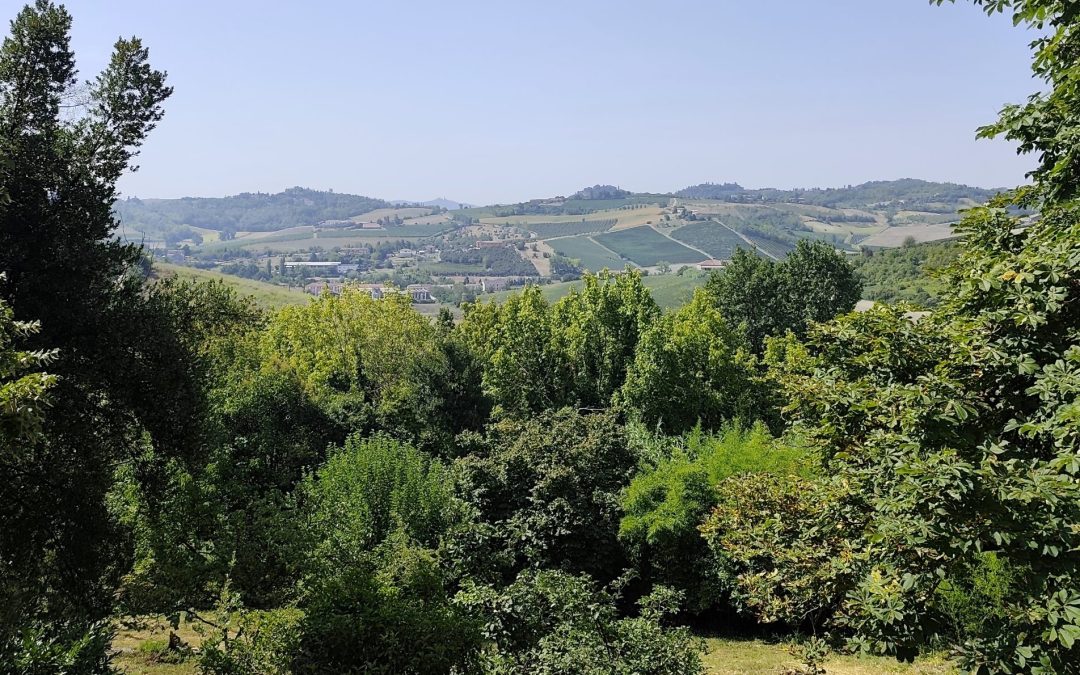
What struck me most, driving between the Langhe and the Monferrato one day, and the Tuscia a few days later, was how differently the same instinct — build with what the ground gives you — produces two completely unrelated architectures. In the Langhe, it’s sandstone, arenaria, the color of wet sand, low farmhouses that seem to grow out of the hillside rather than sit on it. In the Tuscia, it’s tufo — volcanic, porous, carved rather than stacked, entire towns cut into cliffs the way you’d carve a room out of a block. Different rock, different rivers, different rainfall, and the houses answer accordingly. Nobody designed it to be different. The stone simply insisted.
And yet there’s a red thread — un filo rosso — running under all of it, and it isn’t architectural. It’s the relationship between the land and the people who never really left it. In the Langhe, the vineyards climb the exact slope the wine needs and no other. In the Tuscia, towns like Civita and Bagnoregio sit on eroding tufo columns because that’s where the tufo left them centuries ago, and nobody’s moved since. The landscape isn’t a backdrop in either place. It’s closer to a set of instructions the buildings have been quietly following for a thousand years.
I notice this shows up in what my clients choose, too — not consciously, usually, but it’s there. The people drawn to the Langhe are drawn to that particular slope, that particular fog rolling in over vineyards in November. The people who fall for the Tuscia fall for the tufo itself — for towns that look like they were sculpted rather than built. Nobody arrives asking for “sandstone” or “volcanic rock.” They arrive saying a place felt right, and half the time, if you trace it back, it’s the stone underfoot doing the talking.
You don’t need to know the geology to feel any of this. But once you’ve crossed the same rivers in a week, in two different regions, for two entirely different clients, it’s hard not to notice that the whole country is built on this same quiet negotiation between water, stone, and whoever decided to stay.
So if you’re somewhere in this search yourself — Piemonte, Umbria, or anywhere in between — it might be worth asking what the landscape is actually telling you, past the photos and the listing description. Is it the slope your eye keeps returning to? The particular stone under the plaster? A river you hadn’t planned on caring about, until you stood next to it? Most people arrive with a region in mind. Very few arrive knowing which of these quiet things they’re actually looking for — until they’re standing in it.